Best Potty Training Supplies 2026: Top 8 Picks for Toddlers
Find the best potty training supplies in 2026. We reviewed 8 top-rated options including the BabyBjörn Potty Chair, OXO Tot, Munchkin, and more, with a complete guide to starting potty training.
Potty training is a milestone that most daycares require before children advance to preschool rooms — and it is one of the most parent-anxiety-inducing transitions in early childhood. The right supplies make a meaningful difference: a potty chair that is sized and comfortable reduces fear, a step stool that positions the feet correctly improves success, and a potty seat insert allows your child to use the real toilet from day one without a separate portable unit.
We researched the most effective potty training products across child development specialists, pediatric occupational therapists, daycare teacher recommendations, and parent testing to bring you the eight best supplies for 2026.
Our Top Pick: BabyBjörn Potty Chair (under $50)
The BabyBjörn Potty Chair earns the top spot because it gets the fundamentals right: a low-to-the-ground profile that toddlers can mount and dismount independently, a wide comfortable seat, a removable inner bowl that empties without spilling, and construction that will not tip over when a toddler throws their weight. It is the most recommended stand-alone potty by pediatric nurses and childcare professionals because it is stable, easy to clean, and appropriately sized for 18 months through age 3.
For families who prefer a portable option that also works on the regular toilet, the OXO Tot 2-in-1 Go Potty is our runner-up.
The complete BabyBjörn setup: most families end up buying twice, first the floor potty, then a seat for the real toilet once the transition starts. Pairing the potty chair with the BabyBjörn Toilet Trainer (under $50) covers the entire journey in one order: the trainer's adjustable dial fits it snugly to the household toilet, the splash guard actually works, and both pieces are sturdy enough to hand down to every younger sibling.
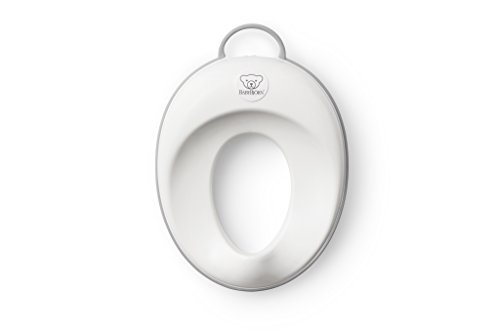
BabyBjörn Toilet Trainer
Adjustable-fit toilet seat trainer with splash guard, the second half of the potty journey, built to the same standard as the potty chair.
Check price on AmazonHow We Chose: What Actually Works for Potty Training
Before getting into individual picks, here is what child development research and childcare professionals identify as the keys to effective potty training supplies:
Child-scaled sizing: A child who can independently approach, sit on, and dismount a potty is more likely to actually use it. Oversized seats create anxiety. Undersized seats are uncomfortable.
Stability: A potty that rocks or tips when a child pushes off from it creates negative associations. The bowl needs to stay put.
Easy cleaning: Potty training involves messes. Removable bowls, non-porous surfaces, and designs without crevices that trap waste make the training period more manageable.
Independent use: The more a child can manage themselves — approaching the potty, pulling down their pants, mounting, dismounting, flushing — the faster they develop confidence and routine.
Daycare coordination: Many daycares have specific potty equipment in their bathrooms. Training at home on equipment similar to what the daycare uses accelerates the transfer of skills.
The 8 Best Potty Training Supplies at a Glance
| Product | Budget | Type | Best Age | Portable | Dishwasher Safe |
|---|---|---|---|---|---|
| BabyBjörn Potty Chair | Under $50 | Standalone potty | 18 mo - 3 yr | Yes | Yes (bowl) |
| OXO Tot 2-in-1 Go Potty | Under $25 | Potty + toilet insert | 18 mo - 4 yr | Yes | Yes |
| Munchkin Arm & Hammer 3-in-1 Potty | Under $50 | Standalone potty | 18 mo - 3 yr | No | Yes (bowl) |
| Ingenuity My Size Potty Pro | Under $50 | Standalone + realistic | 18 mo - 3 yr | No | Yes (bowl) |
| Ingenuity My Travel Potty | Under $25 | Travel potty | 18 mo - 4 yr | Yes | Yes |
| Munchkin Sturdy Toilet Seat Insert | Under $25 | Toilet seat insert | 18 mo - 5 yr | Yes | Top rack |
| Cozy Greens Potty Training Chart | Under $25 | Reward chart | Any | N/A | N/A |
| MooMoo Baby Training Pants | under $50 / 8-pack | Training underwear | 18 mo+ | N/A | Machine wash |
As an Amazon Associate, we earn from qualifying purchases.
Detailed Reviews
1. BabyBjörn Potty Chair — Best Overall
The BabyBjörn Potty Chair is the industry standard for standalone potties. The design is deceptively simple: a low, wide base that will not tip, a comfortable seat with a front guard, and a removable inner bowl that lifts out cleanly for emptying and washing. There are no decoration features that trap waste and no electronic components that can break. The removable inner bowl simplifies daily cleaning.
Best for: Initial potty training from approximately 18 months through age 3.
Watch out for: The minimalist design means there are no "fun" features to entertain reluctant trainers. For children who need more engagement, the Ingenuity My Size Potty Pro may be more motivating.
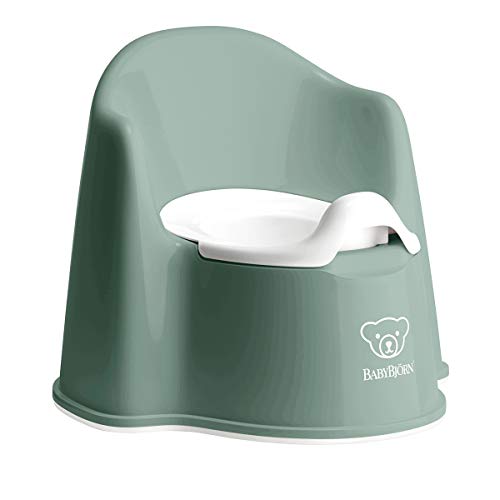
BabyBjörn Potty Chair
Stable low base, removable inner bowl, easy to clean
Check price on Amazon2. OXO Tot 2-in-1 Go Potty — Best Portable and Toilet-Training Option
The OXO Tot 2-in-1 Go functions as both a standalone portable potty (with disposable liners) and a toilet seat insert that sits on the regular toilet. Training on the real toilet eliminates the secondary transition from potty to toilet that many pediatric occupational therapists flag as a common hurdle. The compact fold and included travel bag make it the go-anywhere option for outings, grandparents' houses, and daycare drop-off transitions.
Best for: Families who want one product that works as a portable potty and a toilet insert.

OXO Tot 2-in-1 Go Portable Potty
Standalone potty and toilet insert in one, folds flat with travel bag
Check price on Amazon3. Munchkin Arm & Hammer Multi-Stage 3-in-1 Potty — Best Multi-Stage Standalone
The Munchkin Arm & Hammer 3-in-1 grows with your child: it starts as a standalone potty, converts to a toilet seat insert, and the base becomes a step stool. The built-in Arm & Hammer odor-absorbing disc helps with the smell of a standalone potty between cleanings. The inner bowl removes for cleaning, and the design is comfortable for the extended sitting sessions early trainers often need.
Best for: Families who want one product that covers every stage of training.
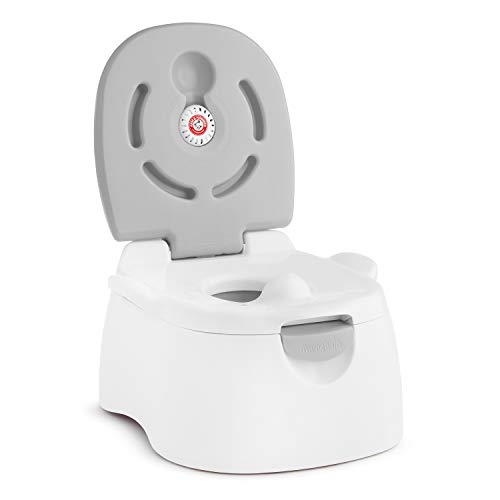
Munchkin Arm & Hammer Multi-Stage 3-in-1 Potty
Potty, toilet insert, and step stool in one, odor-absorbing disc
Check price on Amazon4. Ingenuity My Size Potty Pro — Best for Reluctant Trainers
The Ingenuity My Size Potty Pro is sized like a miniature adult toilet, complete with a lid, a "flusher" that makes a flushing sound, and a removable inner bowl. For children who are afraid of the real toilet (the sound, the scale, or the feeling of falling in), a life-like miniature version reduces anxiety. The realistic design also helps children understand the process they are learning to replicate.
Best for: Children who are hesitant, afraid of the regular toilet, or who respond to novelty and play.

Ingenuity My Size Potty Pro
Miniature realistic design, flush sound, reduces toilet anxiety
Check price on Amazon5. Ingenuity My Travel Potty (2-in-1) — Best Travel and Daycare Use
The Ingenuity My Travel Potty folds flat and works as either a standalone portable potty with disposable liners or as a toilet seat insert on public toilets. For daycare drop-off transitions, travel outings, and public restroom use, this is the essential portability solution. The disposable liners keep disposal clean and hygienic. Many parents use this alongside a home potty during the active training phase.
Best for: Travel, public outings, and families who need a portable solution for daycare transitions.

Ingenuity My Travel Potty 2-in-1
Folds flat, works as standalone or toilet insert, disposable liner system
Check price on Amazon6. Munchkin Sturdy Toilet Seat Insert — Best Simple Seat Insert
The Munchkin Sturdy seat insert is the simplest and most affordable toilet training product: a comfortable seat that fits onto a standard adult toilet, making the opening small enough for a toddler to sit securely without fear of falling in. No step stool, no standalone unit, just a well-designed insert for families training on the regular toilet with a separate step stool already in place.
Best for: Families who already have a step stool and want only the seat insert.
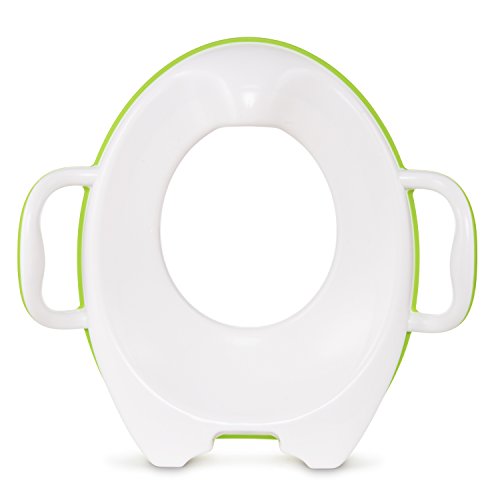
Munchkin Sturdy Potty Training Toilet Seat
Simple seat insert, fits standard toilets, affordable
Check price on Amazon7. Potty Training Reward Chart and Sticker Kit — Best Behavioral Support
The research on potty training is consistent: positive reinforcement accelerates success and reduces setbacks. A dedicated reward chart with sticker completion incentives provides immediate positive feedback for each success, which is motivationally more effective for toddlers than praise alone. The most effective charts use incremental rewards (one sticker per attempt, a larger reward for a certain number of stickers) rather than all-or-nothing systems.
Best for: All families — behavioral support tools work alongside physical supplies, not instead of them.

Cozy Greens Potty Training Reward Chart
Sticker-based positive reinforcement system, reusable chart
Check price on Amazon8. MooMoo Baby Cotton Training Pants — Best Training Underwear
Training pants bridge the gap between diapers and underwear. They work like underwear (the child pulls them up and down) but provide absorbency for accidents during the learning period. The MooMoo Baby reusable training pants are soft cotton with an absorbent layer that helps children feel wetness (important for awareness) while containing accidents. The 8-pack is machine washable, so you reuse them across the whole training period. For daycare specifically, training pants in the toddler room are often required until the center's completion benchmark is reached.
Best for: The active training period, daycare transitions, nighttime training.
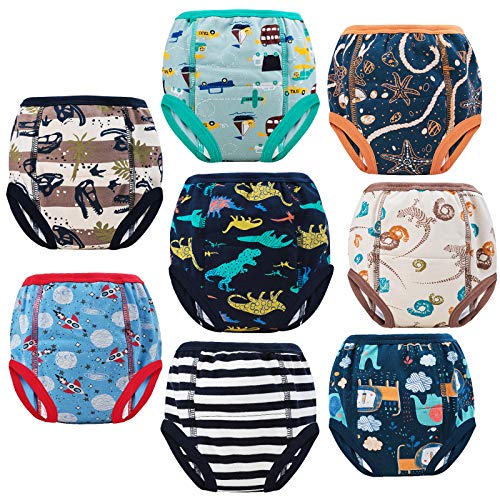
MooMoo Baby Cotton Training Pants (8-Pack)
Reusable cotton, feels like underwear, absorbent layer for accidents
Check price on AmazonBuyer's Guide: Starting Potty Training
Readiness Signs to Watch For
Most pediatricians recommend starting potty training when you observe several readiness indicators, typically between 18-36 months:
- Stays dry for 1-2 hours at a time
- Shows awareness of when they are wet or soiled ("I'm wet")
- Can pull pants up and down with minimal help
- Shows interest in toilet use by adults or older children
- Can follow simple two-step instructions
- Uses some words for elimination
Starting before readiness extends the training period and increases frustration. Starting after readiness can make the process longer and may create the habit of depending on diapers for convenience.
Coordination With Your Daycare
Talk to your daycare teacher before starting home training. Most centers:
- Have their own potty schedule and will work with it at home timing
- May require a specific type of training pant for their bathroom procedures
- Will let you know their policy for transitioning from diapers to underwear full-time
- Can reinforce home training with consistent bathroom breaks at center
Send extra training pants or pull-ups with your child every day during the active training period. Most centers require 3-5 extra changes minimum.
The Two-Week Intensive Approach
Many parents and child development specialists recommend a dedicated 2-week window where potty training is the primary focus at home. The approach involves:
- Removing diapers entirely during waking hours (naked or training pants)
- Offering the potty every 30-60 minutes regardless of cues
- Immediate, enthusiastic positive reinforcement for any success
- Neutral, matter-of-fact response to accidents
- Maintaining the schedule consistently for the full two weeks
Frequently Asked Questions
What age should potty training start?
Most children show readiness between 18-36 months. Girls typically train slightly earlier than boys on average. The American Academy of Pediatrics emphasizes readiness over age — starting too early without readiness signs leads to longer training periods and more frustration for both parent and child.
How long does potty training take?
With a child who shows clear readiness signals and consistent training approach, most children complete daytime training in 2-4 weeks. Nighttime dryness typically follows 3-6 months after daytime training and is considered a separate developmental milestone.
Should I use a standalone potty or train directly on the toilet?
Both approaches work. Standalone potties are lower to the ground and more accessible for very young toddlers (18-24 months). Training directly on the toilet with an insert and step stool eliminates the secondary transition but requires a child who is not afraid of the toilet's scale. A combination of both is common.
My daycare requires the child to be potty trained — when should I start?
Most centers that require potty training for room advancement (typically the preschool room) give adequate notice. If your child's room transition is coming up, start training at least 2-3 months before the expected transition date to allow time for the process.
How do I handle potty training regression?
Regression (returning to accidents after achieving dryness) is extremely common during transitions — new sibling, new daycare room, moving. The most effective approach is to respond neutrally to accidents, continue the regular potty schedule, and avoid displaying frustration. Most regressions resolve within 2-4 weeks if the underlying stressor settles.
Key Takeaways
- The BabyBjörn Potty Chair is the most recommended standalone potty for initial training
- The OXO Tot 2-in-1 Go Potty is the best portable option and works on the regular toilet too
- Coordinate timing and approach with your daycare before starting home training
- Readiness signs matter more than age — starting before readiness extends the process
- Positive reinforcement tools (sticker charts) accelerate training and reduce power struggles
- Send extra changes of training pants to daycare daily during the active training period
Related guides you may find helpful:
Written by
ChildCarePath Team
Our team is dedicated to helping families find quality child care options through well-researched guides and resources.
Related Guides
Back-to-School Daycare Checklist 2026: Everything to Buy Before Day One
The complete back-to-school shopping list for daycare and preschool: nap mat, backpack, lunch box, labels, and the big-ticket gear. Every item is a researched top pick with current prices.
Best Breast Pump for Going Back to Work 2026: Top Picks for Daycare Moms
The best breast pump for going back to work in 2026 is the Spectra S1 Plus. We compared 6 top pumps from Spectra, Elvie, Medela, Momcozy, and Willow for working and pumping moms.
Child Care Ratios by State 2026 and NAEYC Ratios
Staff-to-child ratios for all 50 states and DC: infants 1:3 to 1:6 (1:4 in most states), toddlers 1:4 to 1:11, 4-year-olds 1:8 to 1:18, plus NAEYC ratios and group sizes.
Daycare Cost by State 2026: Average Annual Infant Care Prices
Average annual cost of infant daycare by state for 2026, from $6,800 in Mississippi to over $28,000 in Washington, D.C. Compare all 50 states plus D.C. with published Child Care Aware and EPI data.
Every Child Care Option Available to Colorado Families in 2026
Explore every child care option in Colorado for 2026 — from nannies and au pairs to Head Start and family care. Compare costs, pros, cons, and how to choose.
Best Daycare Labels and Name Tags 2026: Top 8 Picks
Find the best daycare labels and name tags for 2026. We reviewed 8 top options (Mabel's Labels, Name Bubbles, Avery and more) with a comparison table and buyer's guide.