Wildkin vs KinderMat Nap Mat: Which One Does Your Daycare Actually Want? (2026)
Wildkin roll-up nap mats and KinderMat folding rest mats solve different problems. Compare thickness, washability, cubby fit and what most licensed centers ask for.
Buy the Wildkin if your center asks children to bring a full sleep kit, and the KinderMat if your center only wants a mat. The Wildkin is a roll-up with a built-in pillow and attached blanket that goes in the washing machine whole, which is what most preschool and daycare programs mean by "nap mat." The KinderMat is a thicker four-fold foam rest mat with a wipe-clean vinyl shell and no bedding at all, which is what many centers stock themselves and what some ask families to match.
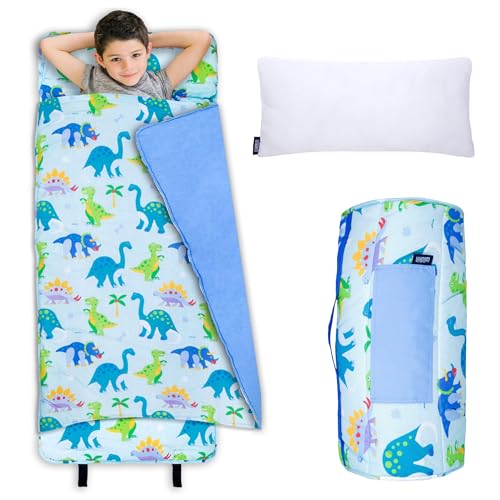
Wildkin Kids Nap Mat with Pillow and Blanket, Preschool Rest Mat, Dinosaur Land
Roll-up mat with an attached pillow and blanket. Machine washable as one piece, which is the single feature that decides most repeat purchases.
Check price on Amazon
KinderMat, Jr. Daydreamer 2 inch Thick Rest Mat, 4-Section Rest Mat, 44 inch x 19 inch x 2 inch
Two inches of folding foam with a sealed vinyl shell. Thicker padding, wipe-clean rather than washable, no bedding included.
Check price on AmazonNap time is a fixed part of the licensed daycare and preschool day, and the mat is usually the one item a center specifies by name. Before you buy either of these, ask the director two questions: what the cubby dimensions are, and whether the center supplies bedding. Those two answers decide this comparison more reliably than any feature list, because a mat that does not fit the cubby goes home again on day one.
A note that applies to neither of these mats but is worth stating plainly: rest mats are for children who have moved past the crib, generally from around age two. Infants sleep on a firm, flat, bare crib mattress with nothing else in the crib, and that is a licensing requirement, not a preference.
Wildkin vs KinderMat at a glance
| Wildkin Original Nap Mat | KinderMat Jr. Daydreamer | |
|---|---|---|
| Format | Roll-up, ties closed | Four-fold, folds flat |
| Padding | About 1 inch quilted fill | 2 inches of foam |
| Bedding | Pillow and blanket attached | None, you supply a blanket |
| Cleaning | Machine wash the whole mat | Wipe the vinyl shell down |
| Typical size | Around 50 by 20 inches | 44 by 19 inches |
| Budget | Under $100 | Under $100 |
Choose the Wildkin Original Nap Mat if…
Your center expects a complete sleep kit and you would rather wash one item than four. The Wildkin rolls into a bundle a three-year-old can carry, the pillow cannot be left behind because it is sewn on, and the whole thing survives a weekly cycle in a home machine. The trade-off is real: about an inch of quilted fill is thin on tile, and the polyester batting compresses over a school year, so treat it as a one-child, one-or-two-year purchase rather than an heirloom.
Check the Wildkin Original Nap Mat on Amazon
Choose the KinderMat Jr. Daydreamer if…
Your child naps on hard tile or laminate, or your center wants a mat that matches the ones it already owns. Two inches of foam is a genuinely different sleeping surface, and the sealed vinyl shell is why centers like it: staff can wipe it between uses without pulling anything out of a laundry rotation. The trade-off is that you now own a mat and nothing else, so a blanket and a small pillow become separate items to label, track and wash.
Check the KinderMat Jr. Daydreamer on Amazon
Before you buy either
Measure the cubby. Standard daycare cubbies vary more than you would expect and a rolled Wildkin is a fatter bundle than a folded KinderMat. Then label everything with the child's full name in a spot that survives washing, because a room of twenty children generates a remarkable number of identical mats.
Related guides
Comparison based on published manufacturer specifications and the general consensus of owner reports. We have not tested these products side by side. Confirm current prices, sizes and specifications before buying. As an Amazon Associate we earn from qualifying purchases, at no extra cost to you.
Frequently Asked Questions
Do daycares supply nap mats or do parents bring one?+
It varies by program and it is worth asking during the tour. Many licensed centers supply cots or rest mats and ask families to bring only a small blanket. Preschools and part-day programs more often ask families to bring the mat itself. Some centers also specify a maximum thickness so the mats stack in their storage rack. Ask the director before ordering, since a mat that does not fit the center's storage will be sent home.
Is a thicker nap mat better?+
Only up to the point where it stops fitting. Two inches of foam is meaningfully more comfortable on tile than one inch of quilted fill, but thicker mats are bulkier to store, heavier for a small child to carry, and some centers cap thickness for that reason. If the floor is carpeted, the extra padding matters much less.
Can an infant sleep on a nap mat?+
No. Infants must sleep on a firm, flat sleep surface in a crib or approved bassinet with nothing else in it, which is both the American Academy of Pediatrics guidance and a licensing requirement in every state. Rest mats are for children who have transitioned out of cribs, typically around age two, and the transition point should follow your center's policy and your pediatrician's advice.
How often should a nap mat be washed?+
Most centers send mats home weekly, and weekly is a reasonable default at home too, since the mat is in contact with the floor and the child's face every day. Wash sooner after any illness. This is the practical reason the Wildkin design wins for many families: a mat that needs to be disassembled before washing tends to get washed less often.
Written by
ChildCarePath Team
Our team is dedicated to helping families find quality child care options through well-researched guides and resources.
Related Guides
BabyBjörn Smart Potty vs Toilet Trainer Seat: Which for Potty Training? (2026)
A floor potty lets a toddler get on and off alone; a toilet seat insert skips the second transition. Compare independence, cleaning and what most daycares are set up for.
Bentgo Chill vs OmieBox: Cold Lunch or Hot Lunch for Daycare? (2026)
Bentgo Chill keeps a cold lunch cold with removable ice packs; OmieBox adds an insulated thermos well for hot food. Compare capacity, leak resistance and daycare practicality.
Brother P-touch CUBE Plus Review: Labelling Everything for Daycare (2026)
A Brother P-touch CUBE Plus PT-P710BT review for parents: Bluetooth label printing up to 24 mm, laminated TZe tapes that survive the dishwasher, running tape cost, and cheaper label options.
Hatch Baby Sound Machine Review: Routine Builder, Subscription Attached (2026)
A Hatch Baby sound machine and night light review: app-controlled routines, sleep guides, the Hatch+ subscription after three months, safe volume for infants, and simpler alternatives.
Hatch Rest vs Yogasleep Dohm: Which Sound Machine for a Nursery? (2026)
Hatch Rest adds a night light, app control and routines; the Dohm is a mechanical fan that never loops. Compare sound quality, features and safe volume for a nursery.
Munchkin Miracle 360 vs NUK Learner Cup: Which First Cup? (2026)
The Miracle 360 drinks like an open cup with no spout; the NUK Learner keeps a soft spout. Compare spill resistance, dental guidance and which one daycare will accept.