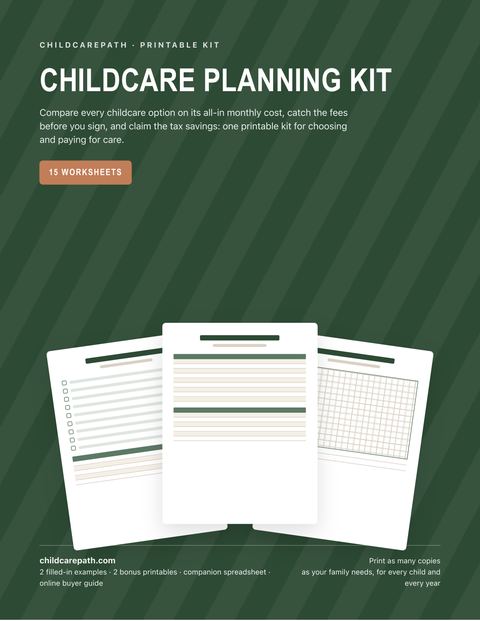
Child Care Cost Calculator: Budget Planning Guide for Families
Calculate your true child care costs with our comprehensive guide. Includes worksheets, budget planning tips, and strategies to make care more affordable.
How much will child care actually cost your family? The sticker price is just the beginning. Between registration fees, supplies, overtime charges, and backup care, the true cost often exceeds the quoted rate by 15-25%. This guide helps you calculate your complete child care costs and create a realistic family budget.
Understanding Your Child Care Costs
Beyond the Base Rate
When a daycare quotes "$1,800 per month," that's rarely the complete picture. Your actual costs include:
Direct costs:
- Tuition/base rate
- Registration and enrollment fees
- Supplies fee
- Meals (if not included)
- Transportation (if provided)
Variable costs:
- Late pickup fees
- Extra hours/overtime
- Field trips and activities
- Summer programs
- Holiday coverage
Hidden costs:
- Backup care when primary provider is closed
- Sick day coverage
- Work missed due to child's illness
- Convenience expenses (rushed mornings = more takeout)
True Cost Calculation Worksheet
Use this worksheet to calculate your complete annual child care cost.
Section 1: Base Tuition
| Item | Monthly | Annual |
|---|---|---|
| Base tuition rate | $_______ | × 12 = $_______ |
| Summer rate (if different) | $_______ | × __ months = $_______ |
| Subtotal: Base Tuition | $_______ |
Section 2: Fees
| Item | Amount | Frequency | Annual Total |
|---|---|---|---|
| Registration/enrollment fee | $_______ | Once | $_______ |
| Annual re-enrollment fee | $_______ | Once | $_______ |
| Supply fee | $_______ | _______ | $_______ |
| Activity/curriculum fee | $_______ | _______ | $_______ |
| Subtotal: Fees | $_______ |
Section 3: Variable Costs (Estimate)
| Item | Est. Per Occurrence | Occurrences/Year | Annual Total |
|---|---|---|---|
| Late pickup fees | $_______ | × _____ | $_______ |
| Extra hours | $_______ | × _____ | $_______ |
| Field trips | $_______ | × _____ | $_______ |
| Special events | $_______ | × _____ | $_______ |
| Subtotal: Variable | $_______ |
Section 4: Backup Care
| Item | Cost Per Day | Days/Year | Annual Total |
|---|---|---|---|
| Daycare closure days | $_______ | × _____ | $_______ |
| Child sick days (backup) | $_______ | × _____ | $_______ |
| Other backup needs | $_______ | × _____ | $_______ |
| Subtotal: Backup | $_______ |
Section 5: Your Total Child Care Cost
| Section | Amount |
|---|---|
| Base Tuition | $_______ |
| Fees | $_______ |
| Variable Costs | $_______ |
| Backup Care | $_______ |
| TOTAL ANNUAL COST | $_______ |
| TOTAL MONTHLY COST | $_______ |
As an Amazon Associate, we earn from qualifying purchases.
Recommended Financial Planning Products
- Family Financial Planner - Organize childcare expenses and family budgeting
- Taja Undated Budget Planner - Track spending and savings goals for childcare costs
- Daycare Labels Pack - Label all your childs daycare supplies to avoid lost items
Cost by Care Type: Comparison Calculator
Daycare Center Calculation
Typical components:
| Component | Low Estimate | High Estimate |
|---|---|---|
| Monthly tuition (infant) | $1,200 | $3,000 |
| Monthly tuition (toddler) | $1,000 | $2,500 |
| Monthly tuition (preschool) | $800 | $2,200 |
| Registration fee | $50 | $300 |
| Supply fee (annual) | $100 | $400 |
| Late fees (estimated annual) | $50 | $300 |
| Backup care (10 days) | $500 | $1,500 |
Sample calculation (toddler, medium-cost area):
| Item | Amount |
|---|---|
| Monthly tuition: $1,500 × 12 | $18,000 |
| Registration fee | $150 |
| Supply fee | $200 |
| Activity fees | $100 |
| Late fees (occasional) | $100 |
| Backup care (8 days × $100) | $800 |
| Total Annual Cost | $19,350 |
Family Daycare Calculation
Typical components:
| Component | Low Estimate | High Estimate |
|---|---|---|
| Monthly tuition (infant) | $800 | $2,000 |
| Monthly tuition (toddler) | $700 | $1,800 |
| Monthly tuition (preschool) | $600 | $1,500 |
| Registration fee | $0 | $200 |
| Supplies (usually included) | $0 | $100 |
| Vacation coverage (backup) | $400 | $1,200 |
Sample calculation (toddler, medium-cost area):
| Item | Amount |
|---|---|
| Monthly tuition: $1,200 × 12 | $14,400 |
| Registration fee | $100 |
| Provider vacation coverage (2 weeks) | $600 |
| Sick day backup (5 days × $100) | $500 |
| Total Annual Cost | $15,600 |
Nanny Calculation
Key components:
| Component | Low Estimate | High Estimate |
|---|---|---|
| Gross salary | $30,000/year | $80,000/year |
| Employer taxes (~10%) | $3,000 | $8,000 |
| Payroll service | $600 | $1,200 |
| Workers' comp insurance | $200 | $500 |
| Health insurance stipend | $0 | $6,000 |
| Paid time off value (~3-4%) | $900 | $3,200 |
| Bonus (1-2 weeks) | $600 | $3,000 |
| Backup care (nanny sick/vacation) | $500 | $2,000 |
Sample calculation (full-time nanny, medium-cost area):
| Item | Amount |
|---|---|
| Gross salary | $48,000 |
| Employer taxes (10%) | $4,800 |
| Payroll service | $900 |
| Workers' compensation | $300 |
| Health insurance stipend | $3,600 |
| Annual bonus (2 weeks) | $1,850 |
| Backup care (10 days × $150) | $1,500 |
| Total Annual Cost | $60,950 |
Nanny Share Calculation
Cost structure (typically 60% of solo nanny per family):
| Item | Per Family |
|---|---|
| Gross salary share | $28,800 |
| Employer taxes (10%) | $2,880 |
| Payroll service (shared) | $450 |
| Workers' comp (shared) | $150 |
| Benefits contribution | $1,800 |
| Total Annual Cost Per Family | ~$34,000 |
Comparing Your Options
Side-by-Side Annual Cost Comparison
Use this to compare your specific options:
| Cost Component | Option A: _______ | Option B: _______ | Option C: _______ |
|---|---|---|---|
| Base tuition/salary | $_______ | $_______ | $_______ |
| Taxes (if applicable) | $_______ | $_______ | $_______ |
| Fees | $_______ | $_______ | $_______ |
| Benefits | $_______ | $_______ | $_______ |
| Variable costs | $_______ | $_______ | $_______ |
| Backup care | $_______ | $_______ | $_______ |
| TOTAL | $_______ | $_______ | $_______ |
Monthly Budget Impact
Calculate what each option means for your monthly budget:
| Item | Amount |
|---|---|
| Total annual child care cost | $_______ |
| ÷ 12 months | = $_______ monthly |
| + Related expenses (commuting, etc.) | + $_______ |
| Total monthly child care budget | $_______ |
| As % of household take-home pay | _______% |
Benchmark: The average American family spends 10-35% of household income on child care. Under 10% is very affordable; over 25% creates significant strain.
Reducing Your Child Care Costs
Tax Benefits
Dependent Care FSA:
- Save up to $5,000 pre-tax on child care
- Reduces your taxable income
- Typical savings: $1,000-$1,500/year
Child and Dependent Care Tax Credit:
- Credit of 20-35% of expenses up to $3,000 (one child) or $6,000 (two+)
- Maximum credit: $600-$1,050 (one child) or $1,200-$2,100 (two+)
- Non-refundable (reduces your tax owed)
Note: You cannot double-dip. FSA and tax credit apply to different dollars.
Sample tax savings calculation:
| Tax Benefit | Calculation | Savings |
|---|---|---|
| FSA ($5,000, 24% bracket) | $5,000 × 24% | $1,200 |
| Tax credit (remaining expenses) | $1,000 × 20% | $200 |
| Total Annual Tax Savings | $1,400 |
Alternative Care Arrangements
Reduce costs by:
| Strategy | Potential Savings |
|---|---|
| Nanny share (vs. solo nanny) | 30-40% |
| Family daycare (vs. center) | 20-35% |
| Part-time schedule | Proportional |
| Sibling discount | 5-15% |
| Employer subsidy | Varies |
| State subsidy (if eligible) | 50-100% |
Subsidies and Assistance
State child care subsidies:
- Income eligibility varies by state (often up to 200-250% of poverty level)
- Can reduce costs by 50-90%
- Search "[your state] child care subsidy"
Free programs:
- Head Start (income-eligible)
- State pre-K (free in many states for 4-year-olds)
- Special education preschool (for children with delays)
Building Your Child Care Budget
Monthly Budget Worksheet
Step 1: Calculate available funds
| Item | Amount |
|---|---|
| Household net monthly income | $_______ |
| Fixed expenses (housing, utilities, etc.) | -$_______ |
| Debt payments | -$_______ |
| Savings goals | -$_______ |
| Available for child care + other variable expenses | $_______ |
Step 2: Determine affordable range
| Calculation | Amount |
|---|---|
| Available amount (from above) | $_______ |
| Target for child care (guide: 10-25% of net) | $_______ |
| Other variable expenses needed | -$_______ |
| Maximum affordable child care budget | $_______ |
Step 3: Compare to options
| Question | Answer |
|---|---|
| Does your preferred option fit? | Yes / No |
| If no, gap between preferred and budget | $_______ |
| Strategies to close gap | ____________ |
If Child Care Exceeds Budget
Options to consider:
-
Reduce child care costs
- Choose less expensive care type
- Reduce hours (part-time schedule)
- Nanny share instead of solo nanny
- Family daycare instead of center
- Apply for subsidies
-
Increase income
- Negotiate raise
- Take on additional work
- Partner increases hours
-
Reduce other expenses
- Temporarily cut discretionary spending
- Reduce savings contributions (short-term)
- Move to lower housing costs
-
Creative arrangements
- Family member provides some care
- Work opposite shifts (if two parents)
- Work from home to reduce care hours
-
Re-evaluate work decision
- If costs approach entire second income, calculate true net benefit
- Consider part-time work during child care years
- See our work vs. stay home calculator
Multi-Year Child Care Planning
Cost Changes Over Time
Child care costs aren't static. Plan for:
Decreases:
- Toddler rates typically lower than infant (~10-20%)
- Preschool rates lower than toddler (~10-20%)
- Free pre-K available at age 4 in many states
- After-school care (age 5+) is much cheaper than full-day
Increases:
- Annual rate increases (typically 3-5% per year)
- Second child adds costs
- Rising wages in your area
Sample Multi-Year Projection
Family with one child, starting infant care:
| Year | Age | Care Type | Monthly Cost | Annual Cost |
|---|---|---|---|---|
| 1 | Infant | Daycare center | $2,200 | $26,400 |
| 2 | Toddler | Daycare center | $1,900 | $22,800 |
| 3 | Age 2 | Daycare center | $1,700 | $20,400 |
| 4 | Age 3 | Preschool | $1,500 | $18,000 |
| 5 | Age 4 | Free pre-K + extended | $500 | $6,000 |
| 6+ | K-12 | After-school | $700 | $8,400 |
Total infant through pre-K: ~$94,000
With second child 2 years later: Total for two children: ~$150,000-$180,000 over the child care years
Planning for Multiple Children
Cost implications:
- Second child nearly doubles costs (minus sibling discount)
- Nanny becomes more cost-competitive with 2+ children
- Family daycare may offer multi-child discounts
- Staggered ages = longer total time in care
Strategies:
- Model out costs before having second child
- Consider care types that scale better
- Look for sibling discounts
- Plan career breaks if helpful financially
Frequently Asked Questions
Q: What percentage of income should go to child care?
A: There's no right answer, but 10-25% of household net income is typical. Under 10% is very affordable. Over 30% usually causes significant financial strain. Many families spend 15-20% during the early years.
Q: Should I reduce retirement savings to afford child care?
A: Ideally no—you can't borrow for retirement. But temporarily reducing (not stopping) contributions during peak child care years is common. Resume full contributions when costs decrease.
Q: Is expensive child care worth it?
A: Quality matters more than price, but they often correlate. A $2,000/month center with low turnover and trained teachers may be worth more than a $1,000/month center with high turnover. Evaluate quality, not just cost.
Q: How do I budget for a second child's care?
A: Start planning before pregnancy if possible. Model the doubled costs and identify how you'll cover them: reduced expenses, increased income, different care arrangements, or timing the second child to start when the first is in cheaper care.
Q: What if I can't afford any quality care?
A: Explore all assistance options: state subsidies, Head Start, free pre-K, and employer benefits. Consider family care, nanny shares, or cooperative arrangements. Part-time care is better than no care. Quality exists at every price point.
Conclusion
Understanding your true child care costs—not just the sticker price—is essential for family financial planning. The worksheet in this guide helps you:
- Calculate complete annual costs including fees, variables, and backup care
- Compare options side-by-side
- Identify tax savings to offset costs
- Create a realistic monthly budget for child care
- Plan for multiple years of child care expenses
Child care is one of the largest expenses young families face, but it's temporary. With careful planning and smart strategies, you can find quality care that works for your budget.
Need more help with child care costs? Check out our guides on how much child care costs, how to afford child care, child care tax credits, and work vs. stay home calculator.
What every centre asks you to bring
Whatever else changes between programmes, the supply list barely does. These four turn up on nearly every one.

Wildkin Nap Mat with Pillow and Blanket
Mat, blanket and removable pillow in one roll, and it is machine washable, which is what decides whether a mat survives a year of daily use.
Check price on Amazon
Skip Hop Sparks Kid's Backpack
Sized for a preschooler rather than a school-age child, so it actually fits a classroom cubby.
Check price on Amazon
Yumbox Original Leakproof Bento Lunch Box
Leakproof compartments a small child can open unaided, which is the whole test for a daycare lunch.
Check price on Amazon
Name Bubbles Custom Name Labels (95 Labels)
Ninety-five waterproof labels in six sizes. Every centre requires everything named, and this covers a full year.
Check price on AmazonThe purchases that actually move the budget
Wipes and labels are noise. These four are where the money in the first two years genuinely goes, and each one is bought roughly once.

Graco 4Ever DLX 4-in-1 Car Seat
Converts from rear-facing infant seat through to a booster, so it is bought once instead of three times. The single largest line on most first-year budgets.
Check price on Amazon
Spectra S2 Plus Electric Breast Pump
Hospital-grade and quiet enough to use at a desk. Worth pricing against formula before you assume it is an expense rather than a saving.
Check price on Amazon
Infant Optics DXR-8 PRO Video Monitor
A dedicated parent unit with no app and no account, so there is nothing to hack and nothing for a sitter to configure.
Check price on Amazon
Toddleroo 3-in-1 Metal Superyard
Turns any room into a safe space you can leave a toddler in, which is the difference between working from home and not.
Check price on Amazon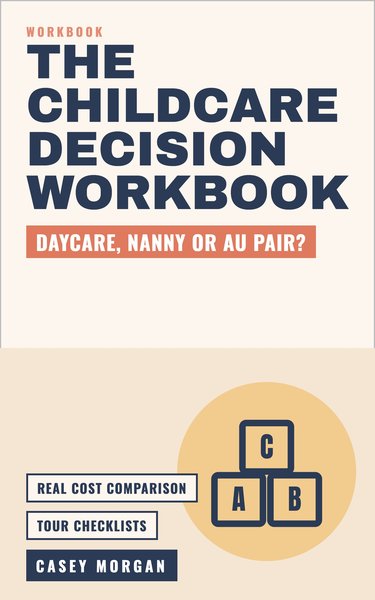
The companion book
The Childcare Decision Workbook
by Casey Morgan
Compare daycare, nanny, nanny share, au pair, and family care by cost and fit, with tour checklists, interview questions, tax worksheets, and a budget planner. A fill-in workbook, so it is printed paperback only.
Written by
ChildCarePath Team
Our team is dedicated to helping families find quality child care options through well-researched guides and resources.
Related Guides
Skylight Calendar Review: A Premium Screen for a Free Problem (2026)
A Skylight Calendar review for busy families: 15.4 inch touchscreen, Google and iCloud sync, chore charts and meal plans, the Plus Plan, and honest cheaper alternatives.
Daycare Cost by State 2026: Average Annual Infant Care Prices
Average annual cost of infant daycare by state for 2026, from $6,800 in Mississippi to over $28,000 in Washington, D.C. Compare all 50 states plus D.C. with published Child Care Aware and EPI data.
Childcare During Divorce: Navigating Custody, Costs & Transitions 2026
Managing childcare arrangements during and after divorce. Custody considerations, splitting costs, helping children adjust, and coordinating between two households.
Affordable Daycare Options: How to Find Childcare You Can Afford
The most affordable daycare options: family child care, nanny shares, co-ops, subsidies, free Pre-K, and Head Start. Every strategy to cut childcare costs in 2026.
Childcare for Military Families: Complete Guide to Benefits & Options 2026
Military childcare benefits, CDC waitlists, fee assistance, PCS moves, deployment care, and finding off-base options. Everything military families need to know.
Childcare for Twins & Multiples: The Complete Parent Guide for 2026
Finding and managing childcare for twins, triplets, and multiples. Cost strategies, same vs. separate classrooms, nanny vs. daycare decisions, and logistics for parents of multiples.