Daycare Cost by State 2026: Average Annual Infant Care Prices
Average annual cost of infant daycare by state for 2026, from $6,800 in Mississippi to over $28,000 in Washington, D.C. Compare all 50 states plus D.C. with published Child Care Aware and EPI data.
Daycare is one of the largest expenses American families face, often rivaling or exceeding the cost of housing. How much you pay depends heavily on where you live: the average cost of infant care ranges from under $7,000 a year in Mississippi to more than $28,000 a year in Washington, D.C.
This guide compiles the average annual cost of infant center-based daycare for all 50 states plus the District of Columbia, drawn from published data compiled by the Economic Policy Institute and Child Care Aware of America. These are statewide averages; your actual cost varies by metro area, provider, and your child's age.
National Average Daycare Cost
According to Child Care Aware of America's most recent Price and Supply analysis, the national average price of child care was about $13,128 per year. Infant care, the most expensive category, runs higher in most states because of the low staff-to-child ratios infants require.
The U.S. Department of Health and Human Services benchmark for affordability is 7 percent of household income. In most states, infant care far exceeds that threshold, consuming 15 to 25 percent of a typical family's income.
Average Annual Infant Daycare Cost by State
The table below ranks states by the average annual cost of center-based infant care. Figures are compiled by the Economic Policy Institute and Child Care Aware of America (data from 2023 to 2024).
| Rank | State | Avg. Annual Infant Care | Monthly Estimate |
|---|---|---|---|
| 1 | District of Columbia | $28,356 | $2,363 |
| 2 | Massachusetts | $26,709 | $2,226 |
| 3 | Minnesota | $22,569 | $1,881 |
| 4 | California | $21,945 | $1,829 |
| 5 | Colorado | $21,840 | $1,820 |
| 6 | Hawaii | $21,167 | $1,764 |
| 7 | Alaska | $20,943 | $1,745 |
| 8 | Washington | $20,677 | $1,723 |
| 9 | Connecticut | $20,254 | $1,688 |
| 10 | Oregon | $19,064 | $1,589 |
| 11 | Maryland | $18,946 | $1,579 |
| 12 | Vermont | $18,836 | $1,570 |
| 13 | New Jersey | $18,155 | $1,513 |
| 14 | New Hampshire | $17,364 | $1,447 |
| 15 | New York | $17,361 | $1,447 |
| 16 | Ohio | $17,071 | $1,423 |
| 17 | Wisconsin | $16,956 | $1,413 |
| 18 | Rhode Island | $16,758 | $1,397 |
| 19 | Delaware | $16,220 | $1,352 |
| 20 | Illinois | $16,107 | $1,342 |
| 21 | Nevada | $15,950 | $1,329 |
| 22 | Arizona | $15,625 | $1,302 |
| 23 | Indiana | $14,471 | $1,206 |
| 24 | Virginia | $14,277 | $1,190 |
| 25 | New Mexico | $14,244 | $1,187 |
| 26 | Nebraska | $14,106 | $1,176 |
| 27 | Pennsylvania | $13,354 | $1,113 |
| 28 | Maine | $13,310 | $1,109 |
| 29 | Missouri | $13,173 | $1,098 |
| 30 | Utah | $13,094 | $1,091 |
| 31 | Florida | $13,021 | $1,085 |
| 32 | Montana | $12,778 | $1,065 |
| 33 | Oklahoma | $12,468 | $1,039 |
| 34 | North Dakota | $12,373 | $1,031 |
| 35 | Tennessee | $12,249 | $1,021 |
| 36 | Georgia | $11,863 | $989 |
| 37 | North Carolina | $11,720 | $977 |
| 38 | South Carolina | $11,512 | $959 |
| 39 | Texas | $10,706 | $892 |
| 40 | Michigan | $10,023 | $835 |
| 41 | West Virginia | $9,692 | $808 |
| 42 | Idaho | $9,630 | $803 |
| 43 | Iowa | $9,605 | $800 |
| 44 | Wyoming | $9,327 | $777 |
| 45 | Kansas | $9,105 | $759 |
| 46 | Arkansas | $8,873 | $739 |
| 47 | Louisiana | $8,873 | $739 |
| 48 | Kentucky | $8,756 | $730 |
| 49 | South Dakota | $8,680 | $723 |
| 50 | Alabama | $7,871 | $656 |
| 51 | Mississippi | $6,868 | $572 |
Source: Economic Policy Institute and Child Care Aware of America (2023 to 2024 data). Figures are statewide averages for center-based infant care; monthly estimates are the annual figure divided by 12. Actual prices vary by metro area, provider, and program quality.
Why Daycare Costs Vary So Much by State
Several factors drive the wide gap between states:
- Cost of living. High-wage, high-rent metros like D.C., Boston, and the Bay Area push provider costs and tuition up.
- Staff-to-child ratios. States with stricter infant ratios require more staff per child, which raises costs.
- Minimum wage and labor markets. Higher local wages for childcare workers translate to higher tuition.
- Regulation and quality standards. States with more rigorous licensing and quality requirements tend to have higher prices.
How to Lower Your Daycare Costs
Even in expensive states, families can cut the net cost of care:
- Dependent Care FSA. Set aside up to $5,000 per year pre-tax through your employer to pay for childcare.
- Child and Dependent Care Tax Credit. Claim 20 to 35 percent of up to $3,000 (one child) or $6,000 (two or more) in care expenses.
- State child care subsidies. Families below income thresholds may qualify for help through the Child Care and Development Fund; apply through your state agency or childcareaware.org.
- Family child care homes. Home-based care is typically less expensive than center-based care.
- Nanny share or part-time care. Splitting a nanny with another family or using part-time care can dramatically reduce costs.
Key Takeaways
- Infant daycare ranges from about $6,900/year (Mississippi) to over $28,000/year (Washington, D.C.).
- The national average price of child care is roughly $13,128 per year.
- Infant care costs more than toddler or preschool care because of lower required ratios.
- These are statewide averages; your local cost varies by metro area and provider.
- Tax benefits and subsidies can cut your net cost by thousands per year.
Related guides you may find helpful:
- How Much Does Child Care Cost? Complete Breakdown
- Child Care Ratios by State 2026
- Child Care Tax Credit Guide
- Nanny Cost Guide
What every centre asks you to bring
Whatever else changes between programmes, the supply list barely does. These four turn up on nearly every one.

Wildkin Nap Mat with Pillow and Blanket
Mat, blanket and removable pillow in one roll, and it is machine washable, which is what decides whether a mat survives a year of daily use.
Check price on Amazon
Skip Hop Sparks Kid's Backpack
Sized for a preschooler rather than a school-age child, so it actually fits a classroom cubby.
Check price on Amazon
Yumbox Original Leakproof Bento Lunch Box
Leakproof compartments a small child can open unaided, which is the whole test for a daycare lunch.
Check price on Amazon
Name Bubbles Custom Name Labels (95 Labels)
Ninety-five waterproof labels in six sizes. Every centre requires everything named, and this covers a full year.
Check price on AmazonThe purchases that actually move the budget
Wipes and labels are noise. These four are where the money in the first two years genuinely goes, and each one is bought roughly once.

Graco 4Ever DLX 4-in-1 Car Seat
Converts from rear-facing infant seat through to a booster, so it is bought once instead of three times. The single largest line on most first-year budgets.
Check price on Amazon
Spectra S2 Plus Electric Breast Pump
Hospital-grade and quiet enough to use at a desk. Worth pricing against formula before you assume it is an expense rather than a saving.
Check price on Amazon
Infant Optics DXR-8 PRO Video Monitor
A dedicated parent unit with no app and no account, so there is nothing to hack and nothing for a sitter to configure.
Check price on Amazon
Toddleroo 3-in-1 Metal Superyard
Turns any room into a safe space you can leave a toddler in, which is the difference between working from home and not.
Check price on Amazon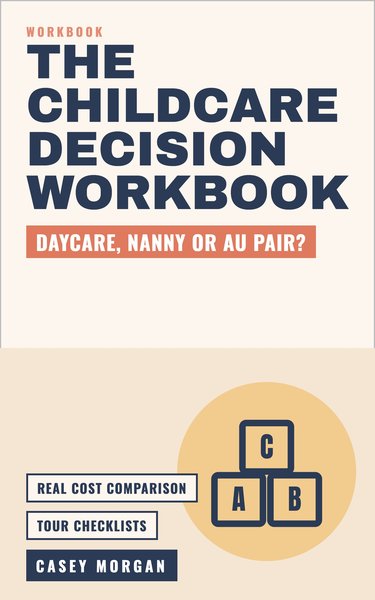
The companion book
The Childcare Decision Workbook
by Casey Morgan
Compare daycare, nanny, nanny share, au pair, and family care by cost and fit, with tour checklists, interview questions, tax worksheets, and a budget planner. A fill-in workbook, so it is printed paperback only.
Frequently Asked Questions
What is the average cost of daycare per year in the US?+
The national average price of child care was about $13,128 per year according to Child Care Aware of America's most recent Price and Supply analysis. Infant care costs more than care for older children, often $11,000 to $17,000 per year for a center, and exceeds $20,000 annually in the most expensive states. Costs vary widely by state, region, and the child's age, with infant care being the single most expensive category.
Which state has the most expensive daycare?+
Washington, D.C. has the highest average infant daycare cost, exceeding $28,000 per year, followed by Massachusetts (about $26,700), Minnesota, California, and Colorado, all above $21,000 annually. These are the priciest markets in the country for infant center-based care. The most affordable states are Mississippi (about $6,900), Alabama, South Dakota, and Kentucky.
Why is infant daycare more expensive than toddler or preschool care?+
Infant care costs more because state ratios require far more staff per child. Most states mandate one caregiver for every three or four infants, compared to one for every ten or more preschoolers. More staff for fewer children means higher labor costs, which are passed on as tuition. Infant care typically costs 20 to 50 percent more than care for a 4-year-old at the same center.
How much of my income should I budget for daycare?+
The U.S. Department of Health and Human Services considers child care affordable at no more than 7 percent of household income. In reality, families in many states spend 15 to 25 percent of income on infant care. To lower the net cost, use a Dependent Care FSA (up to $5,000 pre-tax), claim the Child and Dependent Care Tax Credit (20 to 35 percent of up to $3,000 for one child or $6,000 for two or more), and check eligibility for state child care subsidies.
Are these daycare cost figures the same everywhere in my state?+
No. The figures in this guide are statewide averages. Actual prices vary significantly within a state by metro area, neighborhood, provider type, and program quality. Major cities and high-cost-of-living areas run well above the state average, while rural areas often run below it. Family child care homes are typically less expensive than center-based care. Use these averages as a starting point, then get quotes from providers near you.
Written by
ChildCarePath Team
Our team is dedicated to helping families find quality child care options through well-researched guides and resources.
Related Guides
Skylight Calendar Review: A Premium Screen for a Free Problem (2026)
A Skylight Calendar review for busy families: 15.4 inch touchscreen, Google and iCloud sync, chore charts and meal plans, the Plus Plan, and honest cheaper alternatives.
Childcare During Divorce: Navigating Custody, Costs & Transitions 2026
Managing childcare arrangements during and after divorce. Custody considerations, splitting costs, helping children adjust, and coordinating between two households.
Affordable Daycare Options: How to Find Childcare You Can Afford
The most affordable daycare options: family child care, nanny shares, co-ops, subsidies, free Pre-K, and Head Start. Every strategy to cut childcare costs in 2026.
Childcare for Military Families: Complete Guide to Benefits & Options 2026
Military childcare benefits, CDC waitlists, fee assistance, PCS moves, deployment care, and finding off-base options. Everything military families need to know.
Childcare for Twins & Multiples: The Complete Parent Guide for 2026
Finding and managing childcare for twins, triplets, and multiples. Cost strategies, same vs. separate classrooms, nanny vs. daycare decisions, and logistics for parents of multiples.
Childcare for Single Parents: The Complete Guide to Making It Work in 2026
Navigating childcare as a single parent: finding affordable options, building support networks, handling emergencies, financial assistance programs, and self-care strategies.